Esau seems like a footnote in Scripture. Like Ishmael, he at first comes across as a minor character who needs to get out of the way so the protagonist (Israel) can shine. Save one significant passage, Esau and his progeny are consistently portrayed in a negative light. But a study of Esau and his descendants reveals a glorious God at work in a way that makes tracking his story well worth these precious minutes.
Esau crops up several times throughout the Old Testament. Though modern interpreters can gain valuable insights by studying these passages directly and with a modern mindset, it is perhaps more helpful to consider how the New Testament authors understood him. Two passages in the New Testament focus on the story of Esau. Hebrews 12:15–17 reads:
15 See to it that no one fails to obtain the grace of God; that no “root of bitterness” springs up and causes trouble, and by it many become defiled; 16 that no one is sexually immoral or unholy like Esau, who sold his birthright for a single meal. 17 For you know that afterward, when he desired to inherit the blessing, he was rejected, for he found no chance to repent, though he sought it with tears.
And Romans 9:10–13 reads:
10 And not only so, but also when Rebekah had conceived children by one man, our forefather Isaac, 11 though they were not yet born and had done nothing either good or bad—in order that God’s purpose of election might continue, not because of works but because of him who calls—12 she was told, “The older will serve the younger.” 13 As it is written, “Jacob I loved, but Esau I hated.”
Though both these passages warrant careful inspection in their entire context, the purpose here is simply to understand how the New Testament authors, empowered by the Holy Spirit, understood the story of Esau. (Thus, though the doctrines of divine discipline and election are respectively in view in these two passages, it is not on these that I will focus.) Broadly speaking, these passages make it clear that Esau was a wicked man and that Esau, unlike Jacob, was not chosen or favored by God. However, a closer inspection of Esau’s actual story through the lens of these texts fleshes out the picture much more.
When Esau was born, as recounted in Genesis 25, he was red and hairy like a cloak. The first attribute would become an important epithet; the second is symbolically significant. The word “red” in Hebrew (אָדוֹם) is a paronomasia, a sort of pun, on the word “Edom” (אֱדוֹם). Esau would be associated with “redness” for his entire existence. He traded his birthright for red stew (Gen 25:30), and, interestingly, the land he and his descendants would inhabit was a red one (think of the gorgeous city of Petra, located in this area). “Edom” is a fitting moniker. But the Holy Spirit, through Moses, also draws significant attention to Esau’s hairiness. Scholars suggest different meanings for the word “Esau,” with some claiming it is related to the word for “hairy” (שָׂעִיר, saiyr—think also of Mount Seir in Edom), and others saying it comes from the word for “to do” (עָשָׂה, asah). Either way, further symbolism, in both his name and his hairiness, seems to be implied. Just how hairy was Esau? Hairy enough that, according to Genesis 27, only an animal skin could fool Isaac into thinking Jacob was Esau. Thus, Esau was animal-, perhaps even beast-like from the start. He was a man that was always doing, not thinking—a man of action and impulsivity.
This bears out in the rest of the narrative, and seems to be the way the author of Hebrews understood Esau. Repeatedly, Esau acted on what we might call “animal urges.” This is primarily seen in Esau’s despising of his birthright for the sake of a bowl of stew and Esau’s marrying two Canaanite women (the Hittites were descendants of Canaan’s son Heth) (Gen 26:24, cf. 10:15).
The condemnable meal shows up explicitly in Hebrews 12:16, but the verse also mentions that Esau was both “unholy” and “sexually immoral.” Why unholy? Because in rejecting his birthright, Esau was rejecting the very covenant of God with Abraham. The covenant had transferred to Isaac (cf. Gen 21:12) and would continue through his line. Esau, as firstborn, would have the privilege of being the blessed of the LORD. We see evidence that this was at stake in Isaac’s words of blessing on Jacob in Genesis 27:29: “Cursed be everyone who curses you, and blessed be everyone who blesses you!” This echoes the blessing of Abraham in Genesis 12:3, a connection that is confirmed by Isaac’s words in Genesis 28:4: “May he give the blessing of Abraham to you [Jacob] and to your offspring with you, that you may take possession of the land of your sojournings that God gave to Abraham!” Hebrews bears out this interpretation by recalling the “root of bitterness” of Deuteronomy 29:18, which the context makes clear relates to those who “[forsake] the covenant of the LORD” (v. 25). Thus, Esau rejected the covenant of the LORD, to be both uniquely blessed and the unique blesser of the nations, for a bowl of stew.
In addition to this, Hebrews claims Esau was “sexually immoral.” Considering his narrative, this can only refer to his marriage to the Canaanite women, who were “displeasing” and the cause of “bitterness” to his parents (Gen 28:8; 26:35). The narrative makes clear that Jacob and Rebekah desired their sons to marry descendants of Nahor. Into whom did Esau marry instead? The family of whom it is said, “Cursed be Canaan; a servant of servants shall he be to his brothers” (Gen 9:25). In short, Hebrews demonstrates that Esau was one who forsook the covenant of the LORD for what amounts to lust. He, like a beast, rejected God for a bowl of stew and the pleasures of women, servants and children of the curse though they may have been.
Hebrews demonstrates the reading of Esau as not just a minor character, but a particularly condemnable man whose rejection of the LORD warranted no chance to repent, and who was therefore seen as a striking warning to anyone who might be tempted to follow in his footsteps. But Scripture fleshes out a greater lesson from the story of Esau in Romans 9, one that will require a tour of the story of his descendants. After the debacle with his brother, God gave the land of Edom to Esau and his descendants (see Deut 2:5, 12). Though there was a real prospect for not only peace, but a unification of the two nations (see Deut 23:7–8), Edom met the Israelites with hostility from their first meeting as nations (see Num 20:14–22) and forever following (see Ps 83:1–6), leading to an ongoing relationship of tension and hostility. Finally, in 586 BC, when the Babylonians destroyed Jerusalem and the Temple and took the Kingdom of Judah into exile, Edom mocked the Israelites and perhaps even joined in on their destruction (see Ps 137:1–3, 7; Eze 35:5, 10, 15).
The Edomites, like their patriarch, rejected not only God’s covenant people, but God Himself (see esp. Ps 83:2, 5). The consequence was annihilation. Edom’s reckoning is foretold several places in Scripture, but Jeremiah 49 gives perhaps the most vivid picture: “17 Edom shall become a horror. Everyone who passes by it will be horrified and will hiss because of all its disasters. 18 As when Sodom and Gomorrah and their neighboring cities were overthrown, says the LORD, no man shall dwell there, no man shall sojourn in her.” Because of their treatment of their brother, Israel, Edom would be completely wiped out.
Historically, this proved to be the case. After partnering with Edom in 586 BC, Babylon came back to the area and destroyed Edom in 553 BC. The survivors who remained were pushed out of the land of their inheritance by an Arab tribe called the Nabateans (the ones who built the city of Petra) by about 400 BC, and the Edomites, now displaced, would start being known as the Idumeans. Later, the Maccabean king Hyrcanus, in 126 BC, came against these Idumeans and forced them to convert to Judaism through circumcision. Finally, in 70 AD, they would join with the Jewish people in revolting against Rome, the last time they are ever heard of in history. Time would be well spent linking these events to particular Old Testament prophecies of Edom’s destruction, but the important point is that, in several stages, God poured out His judgement on this wicked people, leading to their indisputable ruin.
Most helpful for understanding Romans 9 is to consider the time of Edom’s displacement by the Nabateans, approximately concurrent with the ministry of Malachi. Malachi 1:2–4, referenced in Romans 9, reads:
2 “I have loved you [Israel],” says the LORD. But you say, “How have you loved us?” “Is not Esau Jacob’s brother?” declares the LORD. “Yet I have loved Jacob 3 but Esau I have hated. I have laid waste his hill country and left his heritage to jackals of the desert.” 4 If Edom says, “We are shattered but we will rebuild the ruins,” the LORD of hosts says, “They may build, but I will tear down, and they will be called ‘the wicked country,’ and ‘the people with whom the LORD is angry forever.’”
We see here that not only did the LORD empty out Edom, but he insisted on it staying that way. Edom’s judgment was final, and they, unlike Israel, would never return to their inheritance.
Now here is the interesting part of the story: Israel was essentially guilty of the same sins for which Edom was condemned. Esau took Canaanites for wives, but so, too, did Judah (Gen 38:2, 12) and Simeon (Gen 46:10). Esau forsook God’s covenant and Edom attacked God’s chosen people, but if there’s one thing the Old Testament shows, it is that the Israelites did the very same thing! By all rights, Malachi should read not “I have loved Jacob, but Esau I have hated,” but “I have hated Jacob, and Esau I have also hated.” Israel did not deserve God’s mercy any more than Edom did. They were ungrateful, unfaithful, unworthy of the promise. Yet God had compassion. He loved Israel, even while he hated Edom. Why? Certainly we could say it was for the sake of the forefathers, but that ultimately only moves the question back a step. Deuteronomy 7:7–8 hints at the final answer: the LORD set his love on them and chose them because the LORD loved them. Or, in the words of Romans 9, He did it “in order that God’s purpose of election might continue.” He did it because He decided to; end of story.
Romans ties this election to the very beginning of Esau’s story. Even before he was born, God chose to reject, to “hate”, Esau; to hold him accountable for his wickedness while choosing to show mercy for Jacob’s. And so, too, with their progenies: Israel was chosen—punished yet rescued and re-placed in their land—but Edom only went from one level of destruction to the next. To one He said, “I will not be angry forever” (Jer 3:12), but of the other He said, “They will be called ‘the wicked country,’ and ‘the people with whom the LORD is angry forever.” Again, why did He choose this disposition toward both, “though they were not yet born and had done nothing either good or bad”? Not because of them, but because of Himself. In the words of Romans 9:15–16, “15 ‘I will have mercy on whom I have mercy, and I will have compassion on whom I have compassion.’ 16 So then it depends not on human will or exertion, but on God, who has mercy.”
To reiterate, I am not really talking here about the doctrine of election, nor am I trying to state a position on it. My point is simply this: in his reading of the story of Esau and Edom, Paul, carried along by the Holy Spirit, was confident in saying that Jacob had ultimately nothing to do with the mercy and compassion that God showed him. And too, because of the context of Malachi, from which Paul quotes, we can extend this to the entire nation of Israel. Israel deserved to be rejected, hated, and left to ruin as Edom was. But God spared them and allowed them to see Edom’s destruction, “desiring to show his wrath and to make known his power, [enduring] with much patience vessels of wrath [Esau/Edom] prepared for destruction, 23 in order to make known the riches of his glory for vessels of mercy [Jacob/Israel], which he [had] prepared beforehand for glory” (Rom 9:22–23). In seeing the rejection of Esau, Jacob saw the treatment he deserved. In seeing the destruction of Edom, Israel saw the riches of God’s glory, knowing that they deserved to crumble just the same.
There is one more two-fold element to consider. We saw earlier that the name Edom was a paronomasia on the word “red.” This is also the case with the word “Adam” (אָדָם). Because of this, Scripture will sometimes start saying something like, “The LORD is enraged against all the nations, and furious against all their host” (Isaiah 34:2), but just a few verses later say, “My sword has drunk its fill in the heavens; behold, it descends for judgment upon Edom, upon the people I have devoted to destruction” (v. 5, emphasis mine). Or a book specifically about the judgment of Edom (i.e. Obadiah, see v. 1) can abruptly say, “For the day of the LORD is near upon all the nations” (v. 15, emphasis mine). Judgment on Edom is closely linked to judgment on Adam, that is mankind. Like Edom, all the nations have rejected God. Like Esau, so have all their constituents. All have sinned and fallen short of the glory of God. We all like sheep have gone astray; we have turned—every one—to his own way. None is righteous, no, not one; no one understands; no one seeks for God. All have turned aside. We all deserve the punishment of Edom.
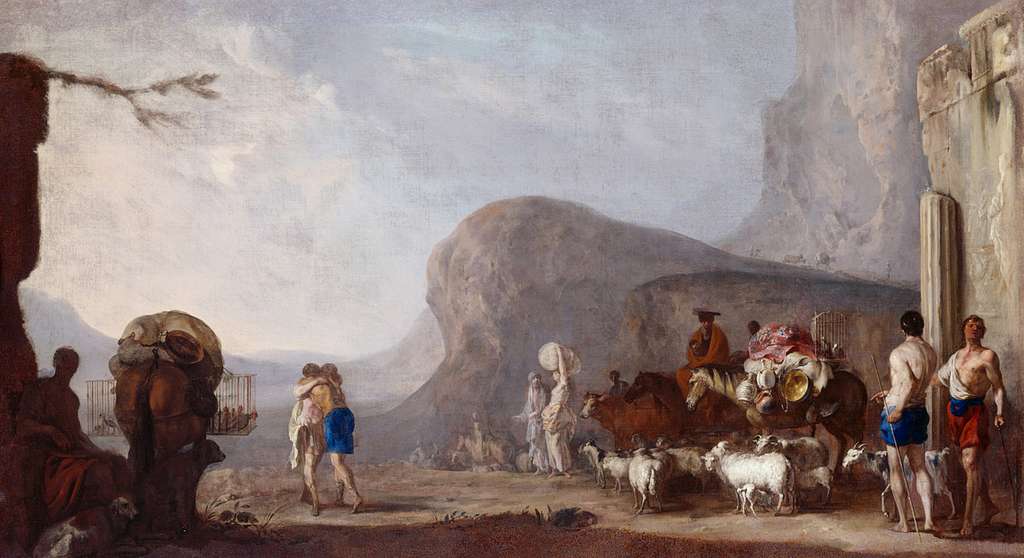
Why is this good news? Because there is one significant passage where Esau seems to be portrayed in a positive light. Though he consistently failed, though he and his progeny are consistently negatively portrayed, there is a beautiful moment that happens because of what God does through Esau. Jacob wrestles with the angel, scared of what Esau might do to him, and what does Esau do? “But Esau ran to meet him and embraced him and fell on his neck and kissed him, and they wept” (Genesis 33:4). Esau makes peace with Jacob. I see Proverbs 16:7 at work here, but the fact remains: this, in some sense, is Esau’s doing. This is remarkable. In fact, no less than Joseph, perhaps the clearest type of Christ in the book of Genesis, is put in a parallel position to Esau in this act… perhaps twice!: Genesis 45:14 says, “Then he [Joseph] fell upon his brother Benjamin’s neck and wept.” Genesis 46:29 repeats, “Then Joseph prepared his chariot and went up to meet Israel his father in Goshen. He presented himself to him and fell on his neck and wept on his neck a good while.” Scholars disagree whether Joseph in this passage is weeping on Jacob’s neck or vice versa. If Esau is put in parallel with Joseph alone, how remarkable must we see Esau’s action. If the second example actually parallels Esau with Jacob, the one who received the covenant instead of Esau, how much more so!
I do not believe Scripture leaves room for Esau in the Kingdom of Heaven, but perhaps by this scene of reconciliation, we are supposed to see that there is hope for Edom. Indeed, in His ministry, “7 Jesus withdrew with his disciples to the sea, and a great crowd followed, from Galilee and Judea 8 and Jerusalem and Idumea [Edom] and from beyond the Jordan and from around Tyre and Sidon. When the great crowd heard all that he was doing, they came to him” (Mark 3:7–8, emphasis mine). Clearly, Edom had an opportunity for peace with Israel (cf. Deut 2:5, 12; 23:7–8) and with Christ. And perhaps, in Edom, so does Adam. There is a legitimate offer of peace with God, even for those in the nations once outside of the covenant promise. As Paul says, referring to the vessels of mercy, “even us whom he has called, not from the Jews only but also from the Gentiles” (Romans 9:24, emphasis mine).
What shall we say, then? Let Esau be a warning and an encouragement to us all. May we resist the sin of Esau and refuse to exchange the covenant of the LORD for objects of lust, and may we wonder at the riches of His glory who has seen fit to make His glory known to Edomites like us.
Particularly Helpful Works Consulted
- Bible Project on the Book of Obadiah
- Barnes’ Notes on the Book of Hebrews
- “What is the meaning of the names ‘Esau’ and ‘Jacob’?” by Rabbi Michael Leo Samuel
 Videre Recte
Leave a comment