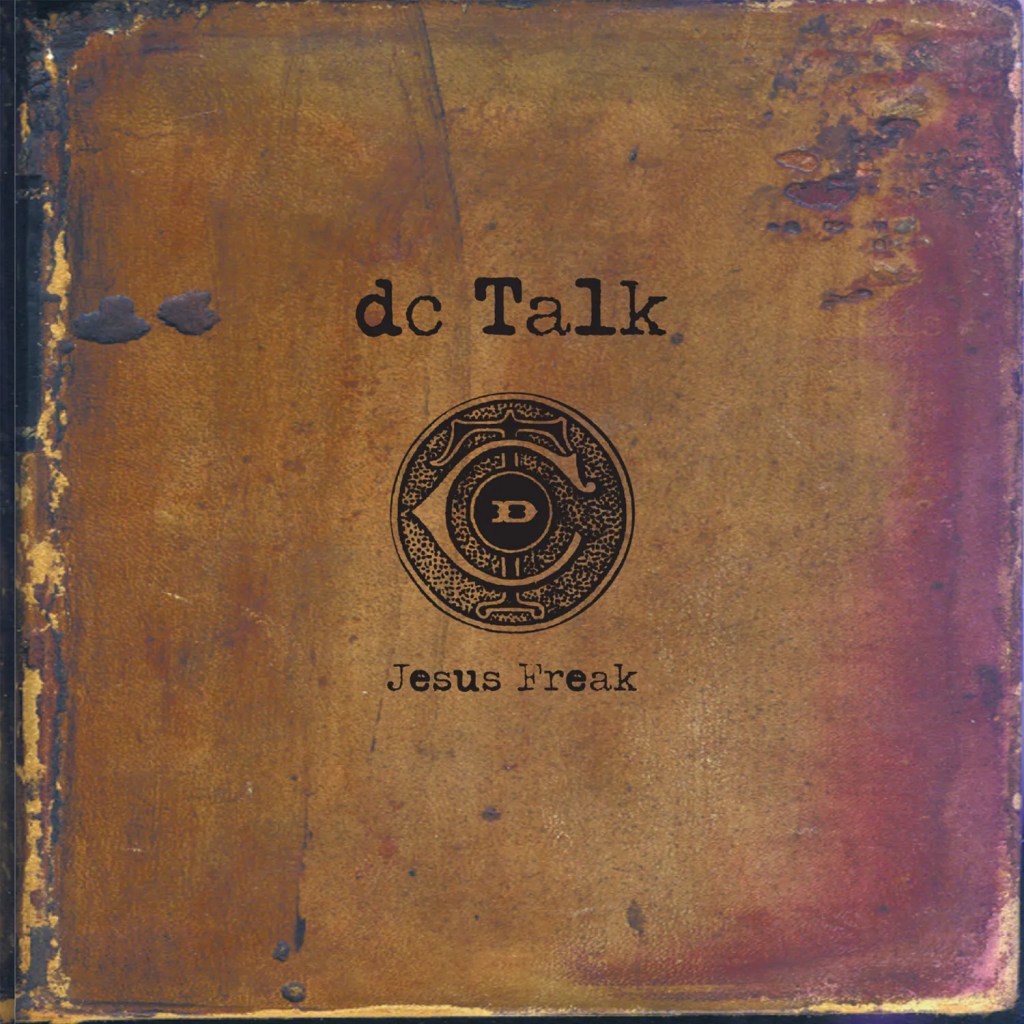
The Beautiful Letdown by Switchfoot, Only Visiting This Planet by Larry Norman, and Jesus Freak by dc Talk all sit in their own league of music. They are lyrically and musically distinct, perhaps endlessly fascinating, and spiritually edifying to boot. The Beautiful Letdown is probably the best of the three, and Only Visiting This Planet is a uniquely jarring beauty to the modern Christian-radio listener; but, in the words of TobyMac’s album opening, Jesus Freak “has something for us, man.”
CCM Magazine called Jesus Freak “Christian music’s Sgt. Pepper’s.”1 They were likely speaking of the huge success and influence of the album, but the comparison holds, too, regarding the excellence of the musical imagination on each. Jesus Freak is a kaleidoscope of musical ideas. dc Talk began their career as a hip-hop group—Nu Thang (1990) is a fine golden-age hip hop album; Free at Last (1992) is perhaps better, and incorporated elements of rock; but Jesus Freak broke the system. It’s rock, it’s pop, it’s hip hop, it’s spoken word, it’s even grunge. It’s not that “there’s something here for everyone,” it’s that the synthesis comes across as effortless. None of the genres feels out of place, and much of the album incorporates elements of all of them.
The songs are beautiful alloys. From the start, the musical journey ahead is made plain: in the first forty-five seconds of the opening “So Help Me God,” we temporarily enter four distinct sonic landscapes, featuring four of the five album genres. The song states its parameters and doesn’t break them, but the parameters are unique and unexpected in their magical synthesis, even after hearing the song umpteen times.
The journey throughout the album is multidimensional. As the beginning of the song is sometimes unrecognizable to its latter parts, one tends to forget which song has “that one part” in it. The journey is salted with skits, as well, adding another dimension to the album experience.
The instrumentation on the album also stands out in this regard. In addition to a standard piano, guitar, bass, and drumkit, Jesus Freak utilizes a Wurlitzer electric piano, a Hammond B3 organ, a Moog synthesizer, an Akai MPC60, finger cymbals, an upright bass, a mandolin, an accordion, a flute, a tambourine, bongos, congas, a cabasa, a cowbell, and a broom. That all three band members perform both lead and backing vocals only adds colors to the palette. And while this certainly isn’t the most extensive array of instruments and voices in history, the diversity certainly add a special flavor to the album.
What does all this mean? It means that even though the lyrics are quality, the harmonies work well, and several songs gratifyingly breach the five-minute mark (more on this in a future article, Lord willing), perhaps the standout aspect of Jesus Freak is its diversity. Jesus Freak is phenomenal because it is brimming with musical imagination.
Yes, Jesus Freak is a great album… or perhaps was a great album. Given the still-recent uncovering of Michael Tate’s particularly heinous sin-habits, one has to consider what to do with it now. When Christian leaders (and unfortunately, that is what I believe all Christian music artists have become in our day) fall from grace, their followers are understandably rattled. A real trust, and even a sort of intimacy, exists between listener and performer. We may not know the artists personally, but we know their voices, we know their perspectives, and we have gained from their expressions of faith, sometimes immensely. And so when a Jennifer Knapp becomes a lesbian, or a Gungor renounces the faith, or a Kirk Franklin is exposed as a filthy-mouthed father, we feel even a little betrayed. In a different way, many Christians struggle when their favorite artist’s Christianity seems to become watered down or otherwise theologically different than we would prefer (looking at you, Lauren Daigle). In either case, some say to throw out their albums, and most wrestle with how to interact with the songs of these artists’ that they once loved.
Part of the difficulty comes from feeling like we are supporting an artist’s decisions when we support them financially or contribute somehow to their popularity. Buying Kansas becomes a $10 donation to Jennifer Knapp’s way of life. Listening to Gungor on YouTube increases the popularity of someone who could lead others away from Christ. These concerns stem from a good heart. Happily, a view on YouTube or a listen on Spotify amounts to less than a one-cent profit for the artist, and neither significantly increases the artist’s popularity. And if one listens to a physical copy of the music, the artist is gaining no new profit at all and, assuming there are no new listeners in the room, no popularity, either. Regardless, the principle question still stands—is it wrong to give money or attention, in any amount, to an artist who is not walking closely with the Lord?
In the end, of course, this will be a matter of conviction, but I firmly believe that giving money to a wayward artist is not inherently wrong, and that increasing the popularity of one of their songs is not tantamount to expressing approval of the artist in general. It is easiest to argue by way of example. First, in a world where listeners universally boycott this artist, what would result? Is the place the artist would end up a positive one? If, hypothetically, it led to their returning from their external waywardness, would it not almost certainly be a hypocritical return? Without a personal relationship with the one “bringing back a sinner from his wandering,” this “discipline” on an artist is likely doing them no good. In other words, Scripture does not have strangers on the internet in mind when it talks about people enacting church discipline, if one wanted to claim that is what this would be.
Second, if someone saw a non-repentant Gungor working as the cashier at the Starbucks from which he wanted to purchase a coffee, should he refuse to buy the drink? In reality, no matter who is behind the counter at the coffee shop, the customer is likely “supporting” their sin-habit in some way. We wouldn’t hesitate to order our chai mocha latte from someone who had, say, a clear drug addiction because we recognize that, in this case, each dollar is a vote for the coffee, not for the person serving it. We pray for the druggy and hand over the small mountain of cash required for the cup of joe.
Third, other than Christ’s, we never recommend someone’s work and example in its entirety. There are no pure sources. Telling someone that this book is very good or that that sermon is very helpful never means that we approve of all the source’s actions or views. This is especially obvious with examples removed by time. Telling someone how much we love “Come Thou Fount” doesn’t bother us because we’ve not heard that by the end of his life its writer was over-friendly with those who denied the deity of Christ. He had, in fact, wandered enough that people still debate his final status as sheep or goat. Somehow, the fact that he died in 1790 makes it clear that we love the song, not the sin of the one who wrote it. Sin, even great sin, is always attached to the creators of great works. Even the lives of Scriptural authors were messy! In the end, pointing someone to something good does not come with all possible strings to the author attached.
It is primarily for this last reason that, even with Michael Tate exposed, I will continue to listen to Jesus Freak. Fundamentally, there is a real distinction between art and artist, and supporting one is not necessarily supporting the other.2
That art and artist are separate should be self-evident. All creations are distinct from their creators—God’s creation, as a prime example, is wholly other to Him. Several other common truths affirm this reality. For example, though an artist dies, their art lives on. An artist can be unknown, and a piece of art can still be known and considered beautiful. An artist can be a fantastic person, but their art might be commonplace. An artist, then, is akin to a shipbuilder; when their ship is complete, they set it sail away from themselves onto the high seas, and it goes places where they never will.
Yes, art has its own existence separate from the artist. Though an author puts pen to paper (or finger to key), most authors recognize that a story fairly creates itself. The words come to them, but they cannot explain how. They are often surprised by the decisions their characters make,3 and they can be slow to understand exactly what they have created. From personal experience, it is entirely possible to understand one’s own creation only long after composing it. Some artists arguably never understand their own art—careful readers of The Giver, for example, seem to understand its world and meaning better than author Lois Lowry did, at least in her Newbery Award acceptance speech.
This all means that the source is actually not most important to consider when considering art. “Pure” art necessarily comes from a polluted stream because it was made by a fallen man. But because the art is separate from the artist, it is not the quality of the stream we are looking at, but the quality of the art. When you see the Mona Lisa floating down the Ganges, you do not call it a filthy painting floating in a filthy river; you take it out, dry it off, and admire its beauty.
Even Scripture seems to indicate that this is the proper view of things. It is not uncommon for beautiful truth to come from surprising sources. John 11:49–53, for example, indicates that God used the mouth of a wicked murderer of Christ to prophesy about the glory to come:
49 But one of them, Caiaphas, who was high priest that year, said to them, “You know nothing at all, 50 nor do you take into account that it is better for you that one man should die for the people, and that the whole nation not perish.” 51 Now he did not say this from himself, but being high priest that year, he prophesied that Jesus was going to die for the nation, 52 and not for the nation only, but in order that He might also gather together into one the children of God who are scattered abroad. 53 So from that day on they planned together to kill Him.
Obviously, Caiaphas was in a special position of grace as high priest (even if appointed by the Romans), but it is still striking that God used the mouth of this man who was far from Him to proclaim beautiful truth.
Paul, too, shows that this principle holds when he expresses Christian doctrine using truths from polluted pagan sources. In Acts 17:28, for example, Paul uses the words of pagan philosopher Epimenides and Stoic philosopher Aratus to describe our relationship to God. In 1 Corinthians 15:33, Paul exhorts the Corinthians by quoting pagan playwright Meander. Although in a different way, Paul also quotes a pagan in Titus 1:12, again Epimenides. And when one reads Plato, one has to wonder whether Paul had done the same.
Perhaps the most striking example of beautiful truth coming from the mouth of a wicked man is in the prophecies of Balaam. The Old Testament indicates Balaam’s condemnability in his death: “They also killed Balaam the son of Beor with the sword… [who] caused the sons of Israel… to act unfaithfully against the LORD in the matter of Peor, so the plague was among the congregation of the LORD.”4 This, of course, is in addition to his prioritizing wealth over the living God. Second Peter 2:15 calls him “Balaam, the son of Beor, who loved the wages of unrighteousness.” Jude 1:11 even lumps him in with the likes of Cain and Korah, absolutely deplorable figures. Other than Esau,5 there are few people the New Testament authors seem to like less than Balaam.
And yet from the lips of this wicked man comes one of the most precious promises in the Old Testament: “I see him, but not now; / I behold him, but not near; / A star shall come forth from Jacob, / A scepter shall rise from Israel, / And shall crush through the forehead of Moab, / And tear down all the sons of Sheth.”6 According to Balaam, the Seed of the Woman was coming! He would shine like a star and rule the nations, crushing the head of the Snake. These words of Balaam are beautiful truth, even if they come from the mouth of a wicked man.
The principle applies elsewhere, as well. Consider these God-glorifying quotes: “The eternal mystery of the world is its comprehensibility… The fact that it is comprehensible is a miracle.” “The soul of man is immortal and imperishable.” “The Christian principle, ‘Love your enemies,’ is good… There is nothing to be said against it except that it is too difficult for most of us to practice sincerely.” “God is the cause of order and the principle of justice in the universe.” “The Christian doctrine of turning the other cheek is the most noble and the most heroic in the world.”
Does it matter who said these quotes? Does the fact that they were all spoken by non-Christians make them any less beautiful or true?
The case can be summarized very succinctly. All Truth is God’s Truth, and all Beauty is God’s Beauty. If an unrighteous man says that Jesus is Lord, let us rejoice that God is advancing His kingdom.7 If a wicked man makes art that reflects the glory of God, let us rejoice, for there is nothing that is Beautiful that is not from God.8 I will rejoice in and recommend Jesus Freak because, though it was made by sinners, God is making His name Beautiful by it, and by the diversity and imagination of its Image-bearing creators, He is revealing His own, infinitely greater diversity and imagination.
Of course, there is still a sadness that arises when I listen to the album now. Praise God that Michael Tate seems to be repentant, but to hear his voice sing, “I wanna be in the Light as you are in the Light,” after all that has happened has a definite impact. There is obviously a component of this sadness that stems from sorrow over sin generally, but in this case, it is the feeling of betrayal. We want our artists to embody what the Greeks called kalokagathia—the man both beautiful and good.9 We want their skill and inspiration as an artist to be matched by their excellence and godliness as a soul. After all, though art and artist are distinct, they cannot be wholly severed from each other. As God’s creation is meant to direct us to God, so the art is meant to direct us, in some way, to the man who made it. Though separate in a real sense, Monet’s paintings still bear the mark of his mind and often even his signature, and the rescued Mona Lisa may still smell a bit like the Ganges after it is dried.
Jesus Freak, along with the many, many other great works from polluted sources, lets us down a bit when we consider its makers. But even this is an opportunity for God’s glory to penetrate through the darkness of the present age. Perhaps by the not-all-that-uncommon experience of artists letting us down, God would have us yearn increasingly for the Perfect Artist—the Artist who will not betray us, the only artist who truly embodies kalokagathia, and the Artist who condescends to help us know Him more through wicked men and imperfect men alike: the Balaams and the Michael Tates.
- Sarachik, Justin. “DC Talk’s ‘Jesus Freak’ Turns Twenty.” CCM Magazine, 20 Nov. 2015, CCMmagazine.com/news/dc-talk-jesus-freak-turns-twenty/. Accessed 26 Aug. 2025. ↩︎
- I say “not necessarily” because there is sometimes too much overlap to claim this distinction. If an artist, for example, is openly promoting sin at their concert, then even if they play “their old songs,” it seems obvious that one is affirming their message by silently attending and therefore apparently approving of the concert and the ones putting it on. There ought to be consequences for false teaching, and, based on the witness of the New Testament, passively standing in its midst is not a viable option. False teachers and unqualified spiritual leaders ought to be called out and, if possible, removed. For these reasons, Michael Tate, as a leader in the Christian world, should stop making music. The severity of his sin means that he has lost, probably permanently, the privilege to lead. ↩︎
- I am indebted to my friend Jean for this insight. ↩︎
- Numbers 31:8, 16 ↩︎
- See my article on Esau here ↩︎
- Numbers 24:17 ↩︎
- Cf. Philippians 1:18 ↩︎
- James 1:17 ↩︎
- Taken from David Hicks’ Norms and Nobility ↩︎


Leave a comment