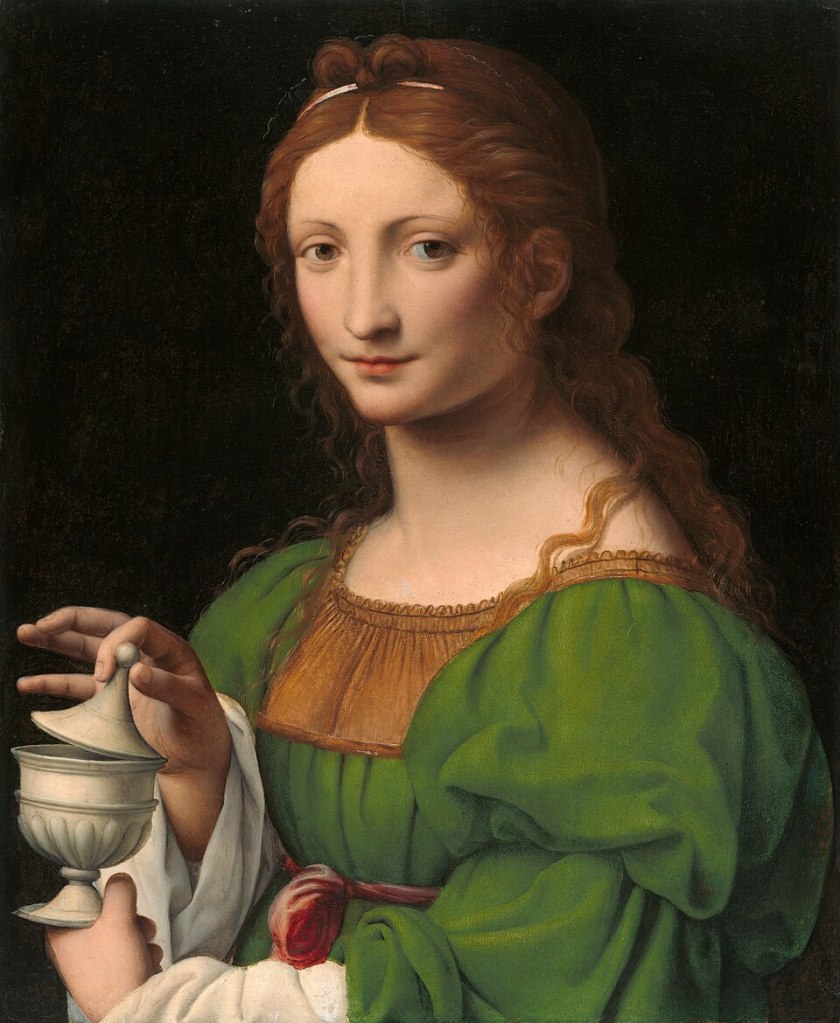
Near the end of the gospel of Mark, the Holy Spirit tells us of two different tables. At the first table is one who anoints Jesus with costly perfume, commonly held to be Mary Magdalene, though her identity is ultimately uncertain. At the second table is Christ’s betrayer, Judas Iscariot. Through the narratives of these two tables, the Holy Spirit invites us, through Mark’s literary craft, to choose at whose table we will sit and how we will respond to the Christ who was at both.
Mark 14:1–21 is meant to be read as a package. The repetition of “Passover” and “Unleavened Bread” in verses 1 and 12, “recline” in verses 3 and 18, and “betray” in verses 10, 11, 18, and 21 demonstrate that these narratives are not only written consecutively but have been intentionally strung together.
The reason for this stringing becomes clear when considering the overall purpose of Mark’s gospel. Throughout his gospel, Mark describes an authoritative Christ, able to heal the sick, cure the leper, give sight to the blind, feed the hungry, cast out demons, walk on water, calm the waves, teach with authority, forgive men of their sins, and foretell His own death and resurrection. The gospel of Mark is designed to invite a proper response to this Jesus by way of example. One can respond like the scribes and Pharisees, who, of course, completely rejected Him. Or he can respond like those who hailed Him as the Messiah. Or like the close followers of Christ, who regularly responded with fear.1
Here, as Christ approaches the hour of His death, Mark puts side by side two quintessential reactions to Jesus. When Jesus shows up at the woman’s table, she uses the most precious thing she owns to honor Him. Biblical-to-present monetary conversions are notoriously hard to compute, but it is probably best to think of the three-hundred-denarii bottle of perfume as worth about $25,000 in modern currency.2 This is the woman’s offering. She did “what she could,”3 pouring what was probably her dowry “down the drain” on Jesus’ head because she knew there was no more worthy place to pour it. He was worthy of it all.
Mark’s portrayal of this woman is simple, touching, beautiful. There is no greater act of worship in the book of Mark than this.
And then there’s the other table in verses 12–21. The Markan sandwich in verses 1–11 demonstrates implicitly what other gospels demonstrate explicitly about the cursed one sitting there. Prior to the scene of the “waste” of perfume, in verses 1 and 2 we are told that the chief priests and scribes were seeking to kill Jesus. Afterward, in verses 10 and 11, we read Judas agreeing to help them do just that . This “bread” of the sandwich is so cohesive that reading just these verses without verses 3–9 is almost seamless.
What we find in the middle of this “bread,” then, is meant to be implicitly connected to Judas’s betrayal, the focal point of conversation at the second table. Because of this construction, it is clear that Judas agrees to betray Jesus over matters related to his indignance over Jesus’ approval of the woman’s “waste” of money. In other words, Judas betrayed his Messiah because he prioritized mammon.
John 12:4–6, in a parallel account, confirms this understanding, stating, “4 But Judas Iscariot, one of His disciples, who was going to betray Him, said, 5 “Why was this perfume not sold for three hundred denarii and given to the poor?” 6 Now he said this, not because he was concerned about the poor, but because he was a thief, and as he had the money box, he used to take from what was put into it.” When Judas sees precious nard poured on Christ’s head, he doesn’t see a beautiful act of worship; he sees an opportunity to thicken his wallet slip through his fingers. That $25,000 would have meant a pretty cut for him, but now, because of the woman’s folly, that opportunity is gone.
Mark does not give us the specific amount Judas accepted to betray Jesus (thirty pieces of silver4), but it is helpful, in order to understand Judas’ heart, to examine the Old Testament passage that the value alludes to. In Zechariah 11:12–13, Zechariah approaches the Israelites, the flock of God, asking them, “If it is good in your sight, give me my wages; but if not, never mind!” The flock understands that Zechariah is asking as a spokesman of God.5 It is clear from verse 13 that the amount they give Zechariah is the value they are ascribing to God. Verse 12 continues, “So they weighed out thirty shekels of silver as my wages.”
This is stunning. To put a price tag on the value of God is blasphemous to begin with, but their offer is certainly worse than that. Thirty shekels of silver is conspicuous for being the precise amount to be given as restitution to a master when one’s animal has killed his slave.6 This allusion is certainly intentional. Israel is approached by the LORD—the One who made them, who chose their father Abraham from among the nations, who provided for them a way to safety in Egypt; the One who brought them out of Egypt with His mighty hand, who provided for them in the wilderness, who graciously overlooked their many offenses there; the One who gave them the Law, who led them into a land they did not deserve, who conquered the inhabitants of the land on their behalf; the One who has been slow to anger and quick to forgive their incessant wickedness since the day He purchased them. They are His slaves.7 What has He not done for them as a gracious and loving master?
And here is their response. When asked for the value of the Creator of the Universe, they reply, “Take this. The price of a dead slave.”
This slap in the face is despicable. It also appears to be prophetic, even within the bounds of Zechariah. It is clear that the New Testament authors connect this valuation of God to Christ, but it is most likely that the passage was intended to be read Messianically, even in Zechariah’s day.8
One possibility is that this section in Zechariah 11 is intended to be connected to two sections in the following chapters. Zechariah 12:10 says, “And I will pour out on the house of David and on the inhabitants of Jerusalem the Spirit of grace and of supplication, so that they will look on Me whom they have pierced; and they will mourn for Him, as one mourns for an only son, and they will weep bitterly over Him like the bitter weeping over a firstborn.” Take away the Legacy Standard Bible’s helpful choices of capitalization, and the antecedent of this “pierced one” is not immediately clear. The most likely candidate, going back from this verse, is the last one to be abused by another in Zechariah, namely, the God who was called worthy of a slave’s restitution.
Later, in Zechariah 13:7, another person is afflicted—this time God’s Shepherd: “‘Awake, O sword, against My Shepherd / And against the man, My Associate,’ / Declares Yahweh of hosts. / ‘Strike the Shepherd that the sheep may be scattered; / And I will turn My hand against the little ones.’” Again, it is not entirely clear who this Shepherd refers to within the context of Zechariah. But again, going back from this verse, the most likely candidate is the one who was pierced in Zechariah 12:10, the God who was rejected in 11:12–13.
Admittedly, this is a hypothesis that needs to be revisited again in the future, and again, and again before being claimed with ultimate confidence. For the time being, I am willing to wager that the original audience of Zechariah was intended to overlay these three passages, understanding that the Shepherd-to-come would be God Himself, and would be rejected for thirty pieces of silver, abandoned, pierced, and mourned.
Whether or not this is the precise understanding we are intended to have of Zechariah, it is clear that all three of these passages are Messianic. Judas’s betrayal of Christ for thirty pieces of silver was clearly tantamount to the shameful assessment of the value of the LORD in Zechariah.9 And though the LORD used it to bring about the redemptive striking of the Shepherd and scattering of the sheep10 and the necessary piercing of His only Son,11 Judas’s betrayal of the LORD’s Messiah was a rejection of the LORD himself, the Creator of all things, for the sake of what amounted to about $10,000.12 In assuming this villainous role, Judas earned the title of the Son of Perdition,13 along with what is sure to be the severest of punishments in hell, about which even Dante could not have much exaggerated.14 Christ was not lying when He said, “Woe to that man by whom the Son of Man is betrayed! It would have been good for that man if he had not been born.”15
By placing side by side these two responders to Jesus at two different precious tables, Mark inherently presents us with a choice. What will we do with this Christ? Will we give him what we can, as the woman did, knowing that He is far more valuable than this greatest honor we could ever give? Or will we, like Judas, find that kind of worship to be better spent on ourselves, and turn our back on God’s Shepherd for the sake of treasures that moth and rust destroy and that we cannot take with us to the horrible place we are going?
May we, with the woman in Mark 14, choose to proclaim the value of Christ properly, and with the angels around the throne sing for all eternity, “Worthy is the Lamb that was slain to receive power and riches and wisdom and strength and honor and glory and blessing, forever and ever. Amen!”16
- 4:41; 6:50; 9:32; 10:32; 16:8 ↩︎
- Mark 14:5; equivalent to about a year’s salary for the average unskilled laborer ↩︎
- v. 8 ↩︎
- Matthew 26:15 ↩︎
- Zechariah 11:11 ↩︎
- Exodus 21:32 ↩︎
- Exodus 19:5; Leviticus 25:55; Deuteronomy 7:6 ↩︎
- Cf. Luke 24:25–27 ↩︎
- See Matthew 27:9 ↩︎
- See Mark 14:27 ↩︎
- See John 19:37 ↩︎
- One silver coin was equivalent to about four denarii. ↩︎
- See John 17:12 ↩︎
- In Dante’s Inferno, Judas is endlessly frozen in the deepest part of hell and eternally chewed on in the mouth of Satan himself. ↩︎
- Mark 14:21 ↩︎
- See Revelation 5:12–13 ↩︎
 Videre Recte
Leave a comment