It is Christmas Eve, and tonight I will have my children snuggled around me on the couch as we make good on an annual tradition and watch A Charlie Brown Christmas together. For me, it is the perfect Christmas movie—a harmonious blend of effortless style and spiritual substance.
Vince Guaraldi’s modest soundtrack is an obvious highlight. Like Mr. Rogers’ Neighborhood, it is a refreshing example of a commitment to giving kids the best instead of the twaddlish kitsch that could have taken its place. “Christmas Time Is Here” is a true gem, and like anything from great “kids” movies, maturity of years only makes it easier to appreciate its simple beauty.
But the magic of Charlie Brown is in a blankie. Linus’s filthy, worn blanket holds the answer to everything Charlie Brown wants to understand about the season. Charlie is at his Charlie Browniest here. He is, of course, depressed. Even his baby sister and his dog have gone commercial. He laments, gazing into a mailbox empty of any holiday greetings, that nobody likes him. And to be fair, nobody seems to much like anyone in the short. Everyone’s a blockhead, someone to slug, someone to extort for money or presents. The “Peanuts” antics, though entertaining for all ages, reveal that though everyone belittles Charlie Brown for asking what Christmas is all about, they all truly ought to be following suit: it is clear none of them knows the reason for the season.
Charlie seeks rest for his restless heart in several places and people, but he finds his first true hope in Lucy’s invitation toward “involvement.” “Me? You want me to be the director of the Christmas play?” he responds, beaming. He comes to rehearsal with a plan and prepared hand motions. But, par for the course, nobody listens to him, and nobody cares about honoring the Playwright’s intent. The play is looking to be a disaster, and Charlie’s hope threatens to die the death of continual frustration.
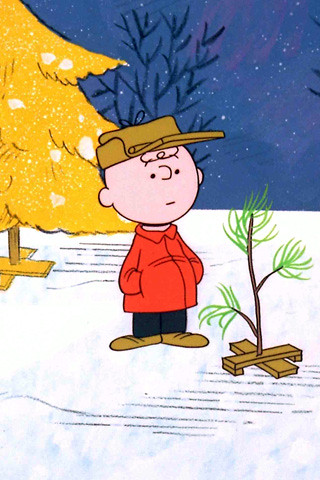
Charlie seeks solace in a Christmas tree. Maybe it will capture the spirit he’s looking for. But the world is against him, and the only trees seemingly available are aluminum. Schultz’s writing is beautiful here. Charlie could not have words for it, but it is evident he is worn out by this fake plastic world. He longs for something Real, beyond the shallow spectres of the day. In the metallic jungle, Charlie sees a glimmer of life in the Old and Good. As Linus quips, “Gee, do they still make wooden Christmas trees?” It is a pathetic, raggedy pine, but it whispers of something beyond what’s seen. Charlie, struck by the fragility of the Real in a fake world, says the tree needs him. He will become its steward and bring it to his friends. This is the scent of what he’s been searching for.
But when he brings it back, he realizes this, too, shall fail him. The crew does not see anything of note in it, and is even repulsed by Charlie’s tree. They do not celebrate. They are not transfixed or transfigured. They only harangue him. He has seen a glimpse of something More, but it is just a glimpse, and he can’t be sure anymore, due to his friends constant criticisms, that there is a Real, a Good at all. He cries aloud in despair, “Isn’t there anyone who knows what Christmas is all about?!” He alone has searched, but unless the Answer reveals itself, that is all he’ll ever do…
But the Answer speaks! Tears never fail to come to my eyes—there is more than just a cartoonist at work in this scene. A boy with a blankie takes center stage. The music stops. The lights are on him alone. There is nothing else that matters than this rest for Charlie Brown’s restless heart. The blankie drops, unneeded in this moment of bliss, and how beautiful are Linus’s feet as he shares:
“Fear not… For unto you is born this day in the City of David a Savior, which is Christ the Lord.”
What is most rapturing about the ending of Charlie Brown is that Charlie, heart now empowered to set itself onto joy, cannot go it alone (woe to the one who falls when there is not a second one to lift him up). He has been alone in his pursuit the whole movie. But his friends, who have hardly been friends up to this moment, have followed him and seen his despair as he “kills” the Glimpse he had found. Linus again leads the way, and, using his blankie once more, breathes vitality into the pathetic pine by giving it all it really needs: “a little love.” The tree is made new, and when Charlie’s friends begin vocalizing “Hark the Herald,” Charlie is drawn in to look upon his friends’ good work. Seeing the tree, he, too, is made new. The Real, indeed, has come. He, like his friends, is visibly changed, and the story ends with smiles, singing, and a hearty “Merry Christmas!”
Every year, Charlie Brown reminds me that though the journey may be difficult, though those around me may not see, the quest to hold onto the Real and find rest for my restless heart is worth the effort. Every year, I am reminded anew that the Real has pierced through this depression-inducing, fake plastic world. Every year I am reminded to take heed of the Glimpses, to nourish and love them, and to nurse the frustrations of friends in the journey, that smiles and singing would illuminate our parched souls until the sea is no more and the Sun shines in its fullness.
 Videre Recte
Leave a comment